Showing posts with label Science Education News. Show all posts

Wednesday, February 6, 2013

Girls are Science Rock Stars (but not in the U.S.)

File:USMC-090507-M-3035F-557.jpg
For years now researchers have been searching for ways to explain why there are so many more men than women in science fields. A recent test given in 65 developed countries by the Organization for Economic Cooperation may hold a piece of the puzzle. The exam finds that among a representative sample of 15-year-olds around the world, girls typically outperform boys in science. The exception: the United States.

The U.S. has jumped on board a STEM education revolution, but what explains the gap? Hannah Fairfield and Alan McLean of the New York Times attributes Andreas Schleicher, who oversees the O.E.C.D., with saying that different countries offer different incentives for learning science and math. He stated that in the U.S. boys are more likely than girls to "see science as something that affects their life." He also references the "stereotype threat."

While women are capable of being very successful in science careers, many choose not to pursue them because of gender roles in occupations and gender norms affect their decision. Researchers suggest that cultural forces like these are eminent in the U.S., Britain and Canada but far less noticeable in Russia, Asia and the Middle East, where a much larger proportion of girls are involved in science and engineering.  In Jordan, for example, girls score more than eight percent better than boys do in science!

Read the New York Times report and check out the graphics.

Thursday, December 27, 2012

Science Classes of the Future

We've all heard it at least once in our lives: "When I was a kid..." Sure, there was once a time that you sat in a science classroom and watched your teacher scrawl on the board, drew a few pictures yourself on a worksheet and called it a day as the bell rang. Once you got home, you opened your textbook and studied more images of what was taught that day in class and that was that.

Now, there's much to be said about these teaching methods, but walk into a science classroom next year and as students learn how chemicals combine to form new substances they're manipulating foam or paper mache models to show how bonds are made, or moving electrons around on a computer screen or tablet, testing what happens when a transfer occurs.

As John Martin on CNN illustrates, science classrooms across America will begin to change next year when 26 states expected to adopt the Next Generation Science Standards (NGSS) implement the new standards in their classrooms. How students effected by NGSS learn will even be different than their older siblings did. 

The goal of NGSS is to have students gain an understanding of science, technology, engineering and math that makes them competitive on a global scale. So what does this mean? It means that students of the next generation will be making models, solving problems and getting messy - hands-on activities that lead to self-discovery and better understanding of subject matter.

Not surprisingly, the most noticeable differences will be seen in classrooms. Listening to lectures and then drawing a model or two will become a thing of the past. Instead, students will create models that represent a cell or an atom - often on a computer - and then use that representation to collect data and make predictions.

Now, if you're worried about the dollar signs that come along with NGSS, don't be. NGSS isn't about fancy, cutting-edge equipment; instead, it's about getting students engaged, involved and excited about STEM fields. Hopefully this will increase their likelihood to pursue STEM careers upon graduation from high school. 

Read Martin's entire report on the future of science classrooms and NGSS.

(And make sure you check out the video embedded in the article. Pay close attention to the first few seconds of the video and you'll see Swift scopes!)

Wednesday, December 19, 2012

Investing in STEM Opportunities for Students

Investing in STEM experiences and futures for today's youth is starting to become a trend that the education world doesn't want to end anytime soon. Just recently, students in Florida and Kentucky were given new opportunities to explore STEM through grants.

Thanks to AT&T Florida, nearly 150 Escambia County students will get the opportunity to explore STEM careers, through a grant received by the Escambia County Public Schools Foundation.  AT&T Florida gave the Consortium of Florida Education Foundations a $100,000 grant to create STEM workplace experiences.  

Pensacola News Journal reported that Ransom Middle and Escambia High will each receive $2,000 in grant money to give students hands-on learning opportunities outside the classroom that are directly linked to their coursework in STEM fields.

Ransom students benefiting from the grant money will build aquaponics systems to raise fish and provide plants for animals at the Roy Hyatt Environmental Center. An additional 22 multimedia student at Escambia High will take a hands-on tour of Nowak Enterprises, where they will get to see the multimedia production process. After that, using new cameras, students will come up with and produce short films for a project.

Over in Kentucky, the JPMorgan Chase Foundation provided their third grant through United Way of the Bluegrass to continue the successful STEM Academy, a community-based extended school day program in partnership with Fayette County Public Schools and First Bracktown, Inc.

The $70,000 grant was the third of a $170,000 total investmen by Chase in this program and will allow the STEM Academy to continue another year and expand to younger students. The program focuses on engaging African-American male middle school students in academically enriched out-of-school activities. To learn more on the grant, read Ky Forward's full report.

Tuesday, December 4, 2012

Building a STEM Nation with "MissionSTEM"

While we all know that STEM fields need to be the focus of education reform these days, the statistics never get easier to take in. In 2009, more than 1.5 million U.S.citizens earned bachelor's degrees, but only a mere 4.4 percent were in engineering and just a small 1.1 percent were in the physical sciences.  Further, only 2.4 percent of the undergraduate degrees earned were in computer science and mathematics represented just 1.0 percent of degrees.

Not surprisingly, the National Science Foundation 's National Center for Science and Engineering Statistics reported that a very small 0.8 percent of all bachelor's degrees earned in 2009 were by women in engineering and 0.2 percent of those earned were by African Americans.

For a country that wants to maintain status as a world leader in STEM, these numbers aren't just startling, they're unacceptable. Just recently, NASA took these statistics to heart and set out to change them. NASA Administrator Charles Bolden said that NASA wants "the nation's STEM degree programs to be more welcoming, supportive and accessible to all students."

With that in mind, NASA launched MissionSTEM.nasa.gov, a Web site created by NASA'a Office of Diversity and Equal Opportunity, to assist colleges and universities in strengthening their STEM programs.  The site connects NASA with its grantees, professional STEM organizations and other interested stakeholders in order to creatively address issues like recruitment and retention of diverse students.

Way to go, NASA! Emerging programs like this one and Change the Equation's iONFuture are steps in the right direction for the nation's STEM future. Combined with NGSS efforts and political legislation, the United States should be starting to move up the competitive STEM ladder.

So, where will we find the future of STEM? As Bolden says, "We will find it in every community, in every university and college and in students of every socio-economic background. The talent is out there. It always has been."

Creating programs like MissionSTEM is just the start. The rest of the battle involves making the commitment to encourage and support American students to pursue their STEM dreams. 


Thursday, November 15, 2012

More Students Interested in AP Science

An Advanced Placement Biology class in Virginia was recently standing-room-only as 27 students crowded around lab tables. Sound like a lot of students? That very same class had 30 students in it the next period. Woodside, the school where so many eager students are enrolling in more science AP classes, is among a group of schools nationwide that are pushing to expand access to AP match and science courses.

With STEM jobs on the rise more than ever before, the push for more AP math and science courses is coming at the right time. Just last year, the U.S. Commerce Department predicted that STEM jobs will grow by 17 percent between 2008 and 2018, compared with just under 10 percent for others.

Recent studies point out the pitfalls in STEM classrooms It's been suggested that U.S. students' match and science skills are slowly growing: in 2011, just 35 percent of eighth-graders were proficient in math and 32 percent in science, according to the U.S. Education Department's National Assessment of Educational Progress (NAEP). 

Another downer: last year, Achieve, made up of business and government officials, found that a mere 20 states (yes, not even half of them) and the District of Columbia required students to complete a "college-and-career-ready" curriculum to earn a diploma.

More schools need to make Woodside their example. With AP courses open to all students regardless of grade-point average, students recruited heavily and trained after school, Woodside treats AP like a sports team. Since many students don't know what AP is or think it's for the valedictorians of the class, this approach can be very effective. 

Woodside also picks  up the cost of the annual exams, making it hard for students to drop the AP courses once they're enrolled. If a student persists, both teachers' and parents' signatures are required for the drop, allowed only after a student attends three tutoring classes. Even then, parents have to meet with a counselor to approve the withdrawal. As you can imagine, it rarely gets that far.

So here's the proof, people. The result of this approach is a 75 percent rise since 2006 in the number of students taking advanced math and science. Higher percentages of students in AP classes can only lead to one good thing: student success (even if your students don't score the highest on the AP exams). Read more about Woodside's AP approach.

Wednesday, November 14, 2012

Swift Helps Drive Science Education

In this changing classroom environment, we understand that teachers need more than products, they need resources and solutions. Let us be your information-hub and offer you the STEM support you need.

From handouts to presentations and microscopy lesson plans, Swift's resource center is where educators, students and professionals need to be. "Smart Teachers Expect More" and they get it here. Discover your STEM classroom with us. 

Swift is doing its part in driving science education. Let us know what are you doing to further STEM education today!


Monday, November 12, 2012

Rediscover Micrographia!

It was way back in 1665 that Samuel Pepys recalled in his diary that he stayed up till 2 a.m. reading an enthralling page-turner and best-seller. He called this text, "the most ingenious book I read in my life." I know, you're on the edge of your seat. What in the world could have kept Pepys up so late and led him to believe he read the best book he'd ever read in his life? If you're thinking it was a book about history, a play or the arts, you're wrong. It was none other than the world's first popular book about microscopic images!

With the short title Micographia: Or Some Physiological Descriptions of Minute Bodies Made With Magnifying Glasses With Observations and Inquiries Thereupon - catchy, I know - the book was authored by famed scientist Robert Hooke. Want to get your hands on it?! Well, good news. The book is now available on Google Books for you to read for free.

As you flip (or scroll) through the book, you'll find wonderful drawings of everything from fleas through bark to the edges of razors. For all you microscope and science junkies out there, it's exciting to see what constituted cutting-edge scientific understanding in 1665! If you're interested, read Carl Zimmer's review to learn more.

Wednesday, November 7, 2012

Energy Research in Front of K-12 Classrooms

Grad students from the University of Nevada, Reno are working with middle school and high school students this fall to present their energy-related science and engineering research to students. What better way to get students interested and involved than bringing the research to the front of their classroom?!

With a $1.2 million grant from the National Science Foundation, students from the College of Engineering will be going above and beyond most traditional graduate school requirements by providing valuable training in teaching, mentoring and communicating science and technology to local schools. The innovative curriculum that engages K-12 teachers and students in STEM is supported by NSF's "Graduate Teaching Fellows in K-12 Education" program.

Like so many other programs being implemented recently, this three-year program is meant to inspire interest in STEM. Through inquiry and project based activities, graduate students and the schools they team up with will encourage middle school and high school students to ask questions that lead them to their own discovery of knowledge and exploration of science. I mean, can it get any better? We need programs like this funded everywhere.

This semester, the energy fellows are working on energy-efficient micro-vehicles, flight dynamics and trajectory planning of descent vehicles and earthquake and structural engineering. Research topics brought to middle school and high school students include energy harvesting using smart materials, nanomaterials for photovoltaics, hydrogen energy and storage, biomass and biofuels, geothermal, wind energy and efficient power grid systems. 

Part of the program: a traveling energy science/technology lab, the E-Mobile! The mobile lab will be outfitted with energy-related demonstrations, exhibits and hands-on projects to excite students and the community about engineering. Find out more about the partnership between the University of Nevada, Reno and Washoe County School District here.

Tuesday, November 6, 2012

Prof. Shares $2.6M Grant to Gauge Success

A public policy professor was awarded a $2.6 million grant this week to help lead a research team testing the success and effectiveness of Advanced Placement high school science courses.

Director of GW's public policy program Dylan Conger will impose a four year study thanks to funding from the National Science Foundation to figure out how effective courses designed to prepare college-ready scientists are.

This is the first study of inquiry-based science learning and College Board, who administers the AP exams, couldn't be more excited. Just recently, College Board revised both its chemistry and biology offerings to test deeper knowledge of topics. Conger will work alongside researchers from the University of Washington and the nonprofit SRI International throughout the study.

Including over 4,000 students in 40 high schools, the study will track students' progress in the AP class and evaluate if the class affects the students' college and career performance in the long run. Conger, like many other advocates of advancing STEM education, believes that tracking the success of AP science courses is critical to understanding U.S. students' progress in technical learning.

Looks like this could be a good first step in helping the country compete globally in STEM fields. Learn more.

Friday, November 2, 2012

Making Sense of Density

Is teaching the concept of density to your students a struggle? Check out how Mr. Treadgold's 7th grade class uses a hands-on project to learn the abstract concept of density. They measure the mass and volume of different cylinders, create their own computerized spreadsheets in Excel for data and enter the formula to calculate density. By the end of the experiment, they're able to conclude on their own that density will not change as the shape and size of an object change, as long as the material it's made of stays the same.

Wednesday, October 31, 2012

The Moticam X is Here - Go Wireless!

That's right, it's finally here! Say hello to the future of wireless digital microscopy and the all new Moticam X.  This all new microscope camera will transform almost any old conventional microscope into a wireless device capable of sending live high resolution images to your WiFi enabled computer, laptop, tablet or cell phone. Using the Moticam X, you can stream your images to up to 6 devices without the need of a router. Can you say jackpot?! 

Since the Moticam X generates its own WiFi signal, this camera can be used separate from your existing network. No additional router is required.

The Moticam X features a CMOS sensor with a 2.0 MP resolution and a WiFi resolution of 1280x1024 pixels. The optical calculation of the camera is 1/3 inch and the focusable lens is 12 mm. The Moticam X also comes complete with eye piece adapters, macro tube, calibration slide and Motic Images Plus software.

What do you say, why don't you unlock and unplug the power of your microscope with the new Moticam X? The possibilities here are seemingly endless! Jump onto the App Store for iOS devices or the Google Play Store for Android devices, download the MotiConnect App and get started...you can't afford to wait another day. Don't have an iOs or Android device? That's okay. Use your WiFi enabled computer or the camera's IP address to view images from almost any HTML 5 supported Web browser!

Click here to learn more about the Moticam X.


Tuesday, October 30, 2012

Stylish Scientists

October 2012 marked the second annual list of the world's most stylish scientists by Furture-ish!

To be nominated for the list, Future-ish looks over 10 diverse variables including things like involvement in science, design, and culture, unique hobbies and of course, a great personal sense of style. The people that make the cut are changing the world with innovative research and changing a stereotypes every time they make an appearance expressing their oh-so-stylish selves.

Now these are the people we need to be looking at! And Future-ish agrees. They hope that they're list of diverse scientists will serve as role models to inspire everyone, from middle-schoolers and the Mom next door to movie stars and musicians, to become informed and engaged in the fields of STEM. At the end of the day, it is these fields that are shaping our future.

On this year's list: two of PBS's Design Squad Nation's very own. Judy Lee (#6) and Nate Ball (#4) each landed a spot on the list. 

Judy said: "I'm totally flattered and honored! I wish there were more awards out there that celebrated breaking old stereotypes. Congrats to everyone."

Nate said: "I'm amused and proud to be a role model in any way, not to mention as an apparently stylish engineer! If you look at some of those other entries, I'm actually wondering why more tech universities don't have modeling schools attached. I guess the list is proof that the words "stylish" and "engineer" aren't mutually exclusive after all!"

If you want to nominate someone for next year's list, send an e-mail with a picture of them and a short bio to studioF@future-ish.com. Self nominations are welcome!

See this year's list.
Nate Ball in the fun engineering clip: Man vs. Sticky Note.

Wednesday, October 24, 2012

Community Colleges Crucial for New Scientists

It's been regurgitated more times than you can count the past few years: the United States needs to grow and diversify it's STEM workforce if it wants to remain competitive with other countries and the new global economy. Something I bet you haven't heard, however, is that community colleges are starting to become more and more important in this process. 

The stats say that more than 50 percent of lower-income and racial-minority students, along with 40 percent of all students, start off at community college. Of all these students, a mere 10 percent even consider a pathway in STEM. And usually, the students that do picture themselves in a STEM field initially change their minds as their studies progress.

The numbers get worse when you look at women. Of the 500,000 associate's degrees earned each year by women at community college's, a depressing five percent are in STEM fields.

Since finances are so important to a number of today's students, community colleges have the flexibility the budget-savvy student needs. The problem: while enrollment at community colleges is up, it's in large part due to one-year technical training programs. Not enough students are transferring to universities to obtain four-year degrees (what you need to get a job in the high-demand STEM fields).

So, how do we get get students to transfer to four-year universities after finishing up at a community college? That's were it gets tough...right now alignment between community colleges and four-year universities is the exception rather than the rule. Frequently, promising future scientists leave their major because certain credits don't transfer or because they don't feel invited into the science community at the university they're looking at. Alignment efforts couple with proper advising can change this!

Read some of Becky Wai-Ling Packard's commentary on the subject.


Friday, October 19, 2012

The Secret Life of Scientists

The misconception that science is a rigid subject for people who play by the rules is enough to turn any girl away from it - and lately it has been. In an effort to bridge the gap between girls and STEM fields, STEM4Girls has compiled a number of videos from various mentors in STEM related fields, showing young girls that women in STEM careers are ordinary women with a passion for what they do - that's all that matters.

Erika Ebbel was studying at MIT when some friends signed her up for a pageant. After realizing that the skills she needed to compete in pageants were important skills to have, Ebbel signed up for another pageant, won it and qualified for the Miss Massachusetts pageant. Ebbel would win that pageant as well. Her story is a great example of how a woman can pursue a STEM career and embody all things beautiful at the same time. 

Watch Ebbel's video below. To view more mentor videos, visit STEM4Girls' website.


Thursday, October 18, 2012

Abdul-Jabbar Promotes STEM Education

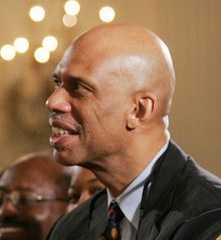
File:Kareem Abdul Jabbar crop.jpgThat's right, Kareem Abdul-Jabbar, the NBA's all-time leading scorer, will serve as California's After-School STEM Ambassador for the next year, promoting the importance of STEM subjects.

"If America is to maintain our high standard of living, we must continue to innovate," Abdul-Jabbar said in a statement published by Education Week. "We are competing with nations many times our size, and STEM learning represents the engines of innovation. With these engines, we can lead the world, because knowledge is real power."

In his new role of After-School STEM Ambassador, the NBA great will make appearances at after-school programs around California to promote STEM education. This will be just another effort on Abdul-Jabbar's part, who has invested a considerable amount of time promoting STEM education the past few years. Through his Skyhook Foundation, Abdul-Jabbar has been actively pushing the importance of STEM education and STEM-related fields.

Abdul-Jabbar was spotted at the U.S. News and World Report's STEM Conference in Dallas earlier this summer pointing out the cultural shift that's necessary to make STEM jobs more attractive to younger generations - especially those in lower-income communities. 

Abdul-Jabbar's role as STEM ambassador in California could take on a particularly high importance in turning around the state's high-quality science instruction. We'll have to stay tuned to see how it goes!

Read more about Abdul Jabbar's involvement in STEM education here.

Wednesday, October 17, 2012

Texas Teacher Named BELS Recipient!

The National Association of Biology Teachers (NABT) recently named Julia Lawrence as the recipient of the 2012 Biology Educator Leadership Scholarship (BELS). Lawrence is a science teacher at McCowan Middle School in Glenn Heights, Texas, just outside of Dallas. Like several other middle school teachers, Lawrence teaches biology, chemistry, physics and earth science. Lawrence says that it's biology that she "really enjoys."

Lawrence has a Bachelor of Science in Biology/Chemistry from Texas Southern University and a Master of Education from Walden University. Before teaching, she was a chemist and lab analyst in the private sector. Lawrence will be using the BELS to pursue a Doctorate of Education in Educational Administration from Texas A&M University - Commerce. 

Lawrence will be officially recognized at the BELS Benefit Dinner at the NABT Conference on Friday, Nov. 2. Lawrence was honored to receive this award.

Tuesday, October 16, 2012

Project Lead The Way Makes STEM History!

Project Lead The Way (PLTW) is the leading provider of rigorous and innovative STEM education curricular programs used in middle schools and high schools. The organization recently released the official 2012-2013 school year registration numbers and what the data reflected was astounding: nearly a 20 percent increase in schools offering PLTW courses to America's students was seen. Cheers to a small victory in STEM education!

For the 2012-2013 school year, PLTW added 1,004 new programs and 747 new schools. The addition of these programs bring the total number of PLTW programs to 5,211. The total number of middle and high schools offering PLTW to their student's is now 4,782 - numbers higher than ever experienced in PLTW history!

The programs mentioned refer to the organization's three middle and high school offerings: the high school engineering program, Pathway to Engineering (PTE); the high school Biomedical Sciences (BMS) program; and the middle STEM curriculum, Gateway to Technology (GTT).

This sudden increase in PLTW programs in America's schools is hopefully a sign of the nation's education priorities and an indication of more STEM growth to come.

Read more about PLTW and their most recent numbers.

Monday, October 15, 2012

Career of the Month

NSTA's career of the month for October is inventor! Dean Kamen, inventor of the segway, is an incredible example of an innovator and entrepreneur. He holds more than 440 United States and foreign patents, many of them for medical devices like the portable dialysis system and an all-terrain wheelchair.  It isn't surprising that Kamen has been inducted into the National Inventors Hall of Fame. He also founded FIRST (For Inspiration and Recognition of Science and Technology), a nonprofit that runs robotics competitions to generate excitement in students about science and technology.

Kamen's advice to students: do what you're passionate about. As he told Luba Vangelova, "Nobody will get really good at something unless they're passionate about it. We all went to gym class, but those who wanted to excel at sports had to commit themselves to practice after school. Science and math are the same."

To find out more and to look at other interesting STEM careers, visit the NSTA website.


Friday, October 12, 2012

STEM Teachers: Be an Einstein Fellow!

The Albert Einstein Distinguished Educator Fellowship Program is now accepting applications for the 2013-2014 Fellowship Year. The Einstein Fellowship Program is available to current K-12 STEM educators with a demonstrated excellence in teaching and leadership.

Selected teachers spend 11 months in Washington, D.C., sharing their expertise with STEM program directors or policy makers. Einstein Fellows may serve in a Congressional office or in one of several government agencies such as the Department of Energy (DOE), the National Science Foundation (NSF), the National Oceanic and Atmospheric Administration (NOAA), or the National Aeronautics and Space Administration (NASA).  Fellows receive a monthly stipend and an allowance for professional travel and relocation. The fellowship year begins in late August 2013.

The goal of the Einstein Fellowship Program is to provide an opportunity for teachers to inform national policy and improve communication between the K-12 STEM education community and national leaders. The Einstein Fellowship Program was created in 1990 with support from the MacArthur Foundation; the 1994 Albert Einstein Distinguished Educator Fellowship Act gave the DOE federal responsibility for the Program. The Triangle Coalition for Science and Technology Education administers the Program for the DOE Office of Science’s in partnership with the other participating federal agencies.

Applicants must be U.S. citizens, be currently employed full time in a public or private elementary or secondary school or school district, and must have been teaching in one or more STEM fields full time in a public or private elementary or secondary school for at least five of the last seven years.

For more information about the program and to learn how to apply, visit www.einsteinfellows.org. Applications for the 2013-14 Fellowship program are due by 11:00 pm EST on Dec. 5.


Thursday, October 11, 2012

STEM Education is Worth It...Literally


Student loan debt stories can make anyone cringe. We all know someone that has six-figure loan debt and is still working on finding a job. Look at the numbers on this table! If you're looking at college from an investment standpoint, your conclusion should be clear: STEM majors are where you're going to find the most bang for your buck.